By the time you sit down to write about your day, you may already have decided what kind of day it was. Busy. Uneventful. Difficult. Good. The description comes easily; the details take a little longer.
There was something else, though. Someone unwrapping a bunch of flowers on the tram. A torn poster revealing another beneath it, for a concert from the year before. A shop you loved, its shutters down and a closure notice on the door.
Field notes give these details somewhere to go. In everyday writing, they are a way of recording what catches your attention while you are living your life, or soon afterwards. A few lines on a page can preserve something that might otherwise disappear beneath the general impression of the day.
What are field notes?
A field note is a written observation made in, or close to, the situation it describes. For personal use, that might mean recording a place, an exchange, an object, a gesture or a change in your surroundings. You can include your own reactions, too.
The word “field” might suggest a distant landscape, but your everyday surroundings offer plenty to write about. The route to work, the supermarket queue, your kitchen at a particular hour: each has details you know so well that you may rarely think to record them.
An entry could look like this:
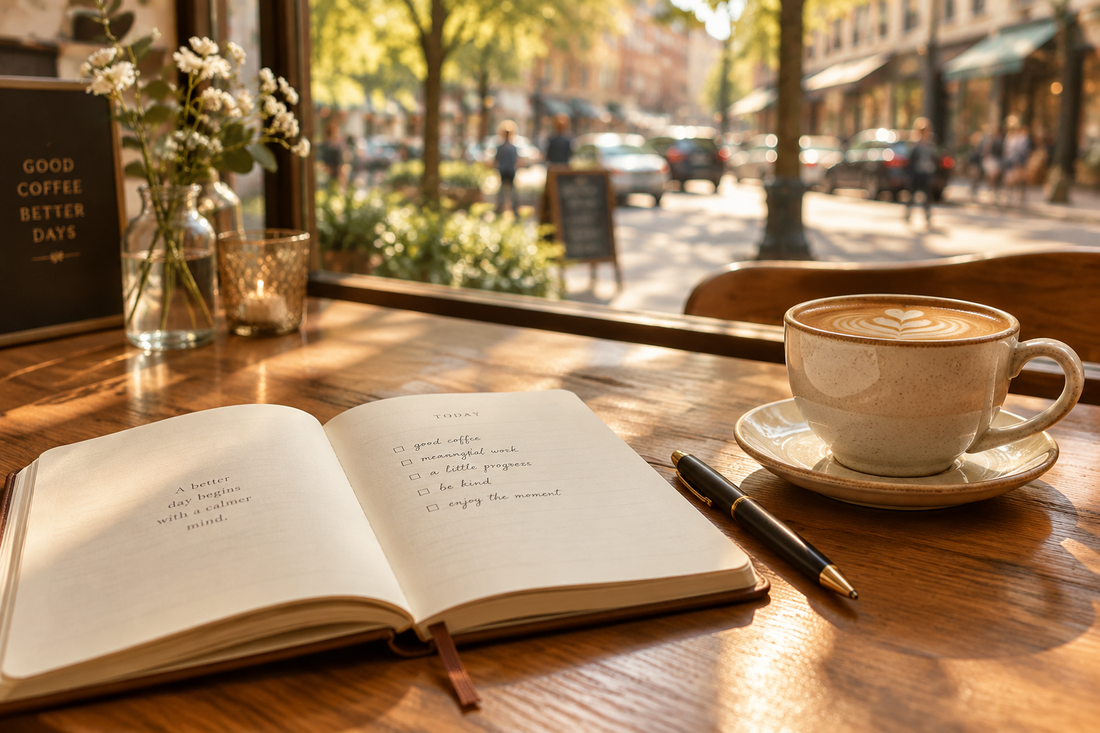
Tuesday, 8.20 am. Coffee shop near the office. The shopfronts across the street are reflected in the window, overlapping with the tables and people inside. For a moment, a bicycle seems to pass through the room. I always choose this seat by the window, but this is the first time I’ve noticed the reflection.
There is a place, a moment, something observed and a personal response. That is enough for an entry. It can remain a few sentences, even if you never return to it.
A different starting point for personal writing
When you write about yourself, you might begin with a feeling or a question. Field notes offer another starting point: something you noticed.
This can be useful on days when you want to write but have little appetite for explaining how you feel. You can describe the room you are sitting in, the conversation you keep remembering, or what has changed along a familiar street. The concrete detail gives you somewhere to begin.
Sometimes it leads towards something more personal. You record the first evening you needed the lamp beside your chair, then realise how much you have been looking forward to spending evenings at home. Or you describe an invitation left on the kitchen table and find yourself writing about why you have yet to answer it.
The connection can emerge as you write. You can also leave the observation exactly where it is. A record of the lamp, the room and the evening has value on its own.
What catches your attention?
You could stand beside someone on the same street and come away with entirely different notes. They might remember the buildings; you might remember a person pausing at a doorway, or a colour repeated in several windows.
This is part of what makes field notes personal. Your attention gives the page its particular character. Over time, you may notice recurring interests: the ways people arrange their belongings, signs of change in a neighbourhood, things being repaired, the language people use when saying goodbye.
Those interests do not need an explanation straight away. You can follow them simply because they make you curious.
Being specific helps. “The street felt different” leaves little to return to. “The bakery has taken down its red awning; I walked past the door before recognising it” preserves the detail that made you feel the difference.
When writing about other people, leave room for what you do not know. “He checked his phone three times while we waited” records something you saw. “He was impatient” adds an interpretation. You may want both in your notes, but keeping the distinction clear can make the writing more thoughtful. Private observations also deserve care if you later choose to share them.
How to begin
Choose a notebook you can comfortably carry and a pen you enjoy using. A small format makes it easier to write a few lines while you are out; a larger one gives you space to add a sketch or a longer passage later.
Start with the date and the place. Then record one thing that held your attention. These questions can help you find the detail:
- What did I notice here that I would probably leave out of an account of my day?
- Which exact gesture, sound, colour or phrase caught my attention?
- What has changed in this familiar place since I last looked closely?
- What did I observe, and what am I assuming about it?
- What would I need to write down to picture this moment again?
You can use fragments, lists or complete sentences. If you are writing later, mention what you are uncertain about rather than filling in the gaps. The entry belongs to you; it does not need to sound like anyone else's idea of good writing.
Returning to your notes
After a few pages, read back through what you have collected. One observation might become the beginning of a longer piece of personal writing. Another might bring back a whole afternoon through a single detail.
You may also find that ordinary entries become more interesting with time. The view from a window before you moved. A phrase someone used often. The arrangement of a room before its purpose changed. What seemed too familiar to describe can later be precisely what you want to remember.
A notebook gives those observations a place to accumulate. Start with something from today that you can still picture clearly. Write down enough to return to it.
Next steps
-
If you want one clear question to follow today, use: Journaling prompts for beginners
-
For a gentle reset, try Look Back, Move Forward. Reflection Prompts For A Reset
-
If you are brand new and want the basics, read How to Start Journaling
- Choose a notebook for Journaling from our Writing Set Collection


